


Best Countries for Jobs in 2026

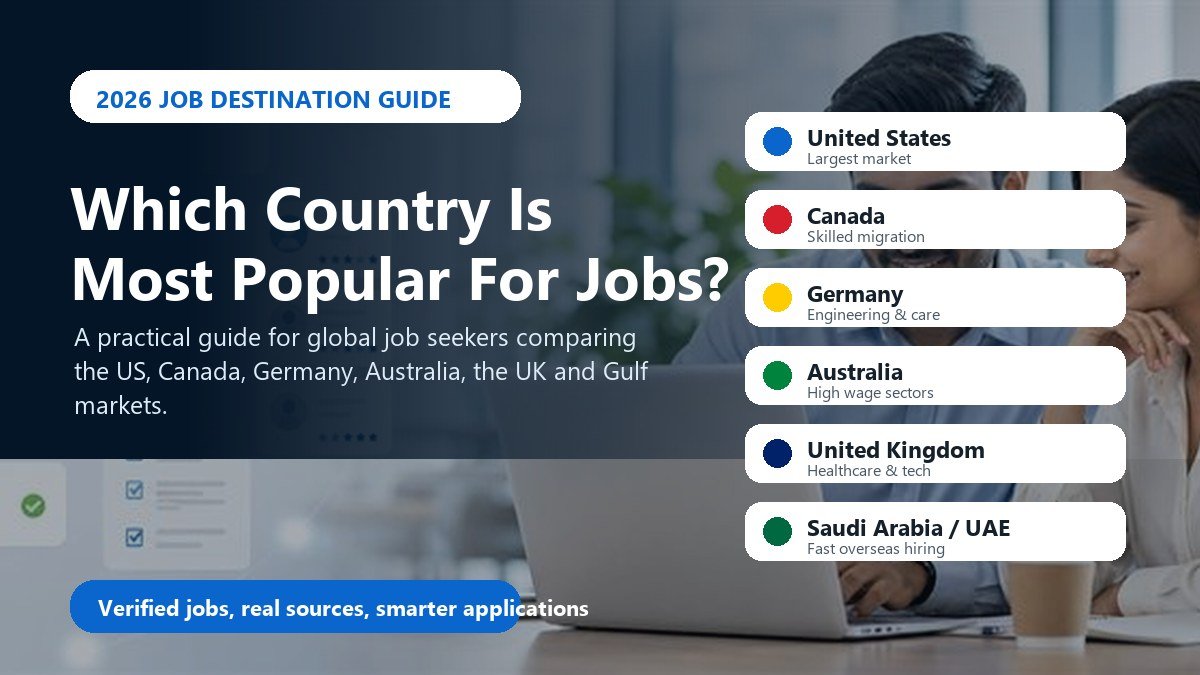







If you ask job seekers which country is most popular for jobs, the quick answer is usually the United States. It has the largest global economy, a broad technology and services market, many multinational employers, and a long history of attracting skilled professionals. But the smarter answer is more personal: the best country for jobs depends on your profession, visa path, language, salary expectations, and how quickly you need to start working.
For 2026 job seekers, popularity should not mean hype. A country can be popular because it has many openings, because it offers work visas, because salaries are high, or because workers from abroad already have strong networks there. This guide compares the most common choices and gives a realistic note for candidates applying from Pakistan, Saudi Arabia, India, Africa, Europe, and other international markets.
1. United States: the widest job market
The United States remains the most visible country for jobs because it has a huge employer base across technology, healthcare, finance, logistics, education, engineering, sales, marketing, and remote work. The U.S. Bureau of Labor Statistics continues to publish large-scale labor market data, including job openings, hires, unemployment, and work-from-home trends, which makes the market easier to track than many others.
The challenge is entry. Many international candidates need an employer-sponsored visa, and competition is strong. The United States is best for highly skilled workers, experienced software professionals, healthcare specialists, researchers, finance experts, and people who can apply through official employer career pages with a strong resume and portfolio.
2. Canada: popular for skilled migration
Canada is one of the most popular countries for jobs because the immigration system is more structured for skilled workers than many other destinations. It is especially attractive for healthcare workers, IT professionals, trades, engineers, truck drivers, educators, and candidates who want a long-term settlement path rather than only a temporary contract.
Canada is not easy, though. Cost of living, credential recognition, local experience, and licensing can slow down new arrivals. Candidates should check provincial demand, not just national popularity. A nurse, electrician, early childhood educator, or software developer may find very different opportunities depending on the province.
3. Germany: strong for engineering, healthcare, and skilled trades
Germany is one of Europe's strongest job markets for skilled workers. The European Labour Authority reports that labour shortages remain structural in key sectors across EURES countries, with health and care roles facing severe and persistent shortages. Germany is also known for engineering, manufacturing, IT, logistics, and vocational skills.
The main barrier is language. Some international tech jobs use English, but healthcare, education, trades, and public-facing roles usually need German. For job seekers who are willing to learn the language and prepare documents properly, Germany can be one of the best long-term career destinations in Europe.
4. Australia: attractive but competitive
Australia is popular for jobs because it combines high wages, an English-speaking work environment, and demand in healthcare, construction, engineering, education, hospitality, agriculture, mining, and technology. It is especially attractive for candidates who want a mix of work opportunities and quality of life.
The realistic note is that Australia uses skills lists, licensing, and points-based rules. A job seeker should not only search for open roles, but also check whether the occupation is eligible for the right visa pathway. A strong English test score, verified qualifications, and relevant experience can matter as much as the job application itself.
5. United Kingdom: good for healthcare, care, tech, and services
The United Kingdom remains popular because it is English-speaking, internationally connected, and active in healthcare, care work, finance, education, hospitality, construction, logistics, and technology. Many candidates also prefer the UK because its job descriptions and application systems are easier to understand for English-speaking applicants.
The UK has changed several migration rules in recent years, so candidates should read official visa guidance before making plans. A role may look attractive, but the employer must be eligible and willing to sponsor where sponsorship is required.
6. Saudi Arabia, UAE, and the Gulf: fast hiring for many workers
For many workers from Pakistan, India, Bangladesh, Nepal, the Philippines, and Africa, Saudi Arabia and the UAE remain among the most practical job destinations. Hiring can be faster in construction, hospitality, retail, driving, maintenance, healthcare support, security, administration, oil and gas, and increasingly technology and digital services.
The Gulf market is different from Canada, Germany, or Australia because many jobs are contract-based and tied to the employer. Candidates should check salary, accommodation, transport, visa cost, contract terms, and recruitment fees carefully. A real job offer should come with a clear employer, role, salary, location, and legal work process.
So, which country is most popular for jobs?
If we measure by global attention and market size, the United States is the most popular country for jobs. If we measure by skilled migration pathways, Canada, Australia, and Germany become very strong choices. If we measure by fast overseas employment for South Asian workers, Saudi Arabia and the UAE are often more practical. If we measure by healthcare and care demand, Germany, the UK, Canada, Australia, and several European countries all deserve attention.
The best country is the one where your skill, language, experience, visa route, and salary expectation meet real employer demand. A graphic designer may target remote U.S. or UK roles. A nurse may compare Germany, Canada, the UK, and Australia. A technician or driver may find faster opportunities in Saudi Arabia or the UAE. A software engineer can apply globally, but should still check visa sponsorship and remote-work rules.
How to search for international jobs
Use a specific role, destination, and eligibility need instead of one broad search. For example, look for IT jobs in Canada with sponsorship, engineering jobs in Germany for English speakers, Saudi Arabia jobs for Pakistani technicians, UAE hospitality jobs with accommodation, or remote roles open to your country.
Before applying, verify the employer website, compare the salary with local living costs, avoid paying illegal recruitment fees, and keep your CV focused on the country and role you are targeting. A country may be popular, but a focused application is what gets interviews.
Research sources
This article uses public labour market context from the OECD International Migration Outlook 2025, the U.S. Bureau of Labor Statistics, the European Labour Authority 2025 labour shortages report, and the World Bank unemployment indicator.
- Share This Job

Write A Comment
No Comments