


How to Match Your Resume to a Job Description

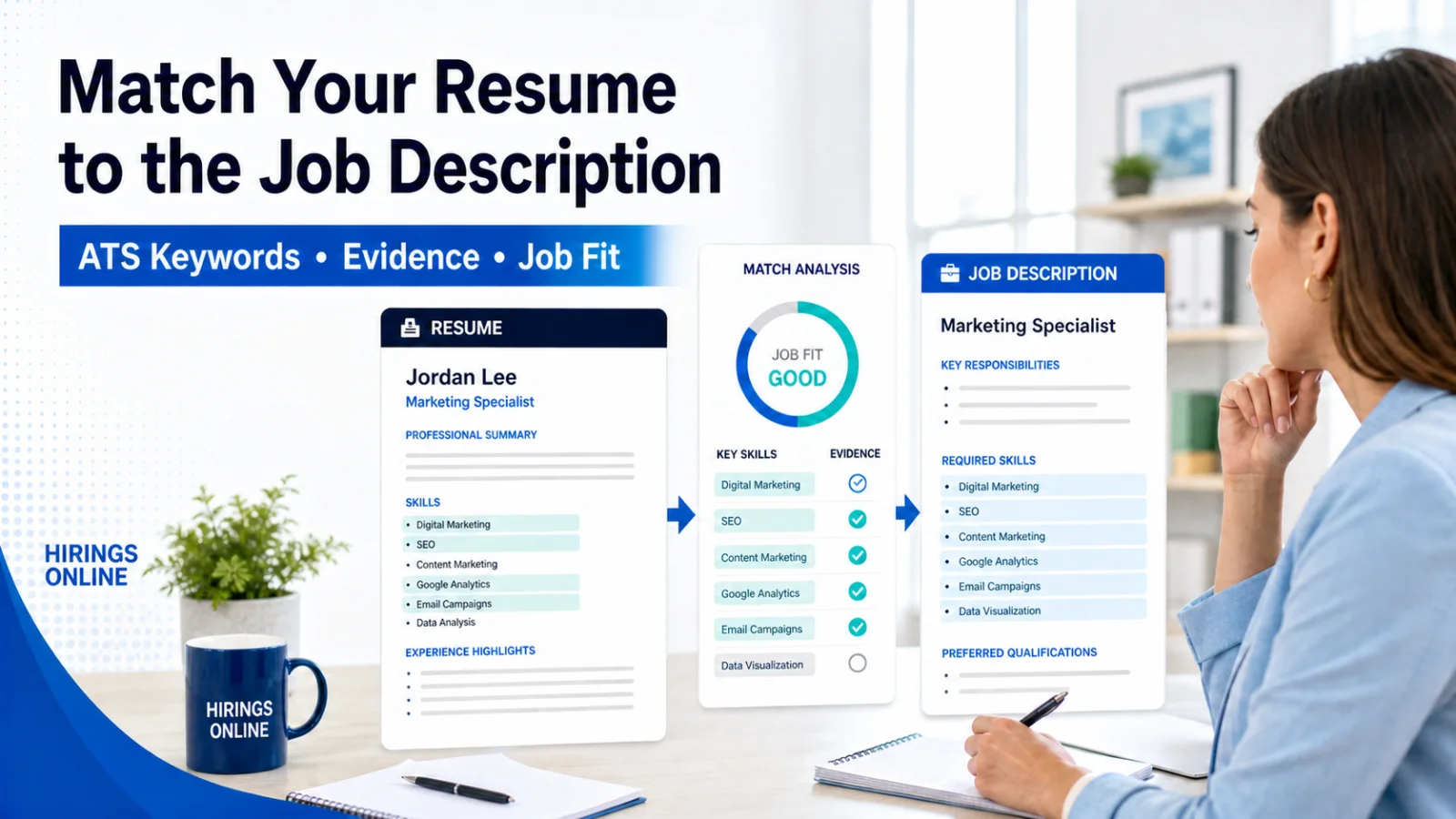
Short answer: match your resume to a job description by separating the advertisement into required skills, responsibilities, tools, outcomes, and eligibility; then connect each relevant requirement to truthful evidence from your work, education, projects, or training.
The aim is not to copy the advertisement or chase a perfect ATS score. It is to help both screening software and a human recruiter see why your real experience fits this particular role.
What does it mean to match a resume to a job description?
A resume job match is the overlap between what an employer asks for and what your resume can prove. A generic resume may contain your complete history but leave the most relevant evidence buried. A tailored resume keeps the facts the same while changing the order, emphasis, and wording so the target role is easier to understand.
This distinction matters during an ATS job search. Some applicant tracking systems store, parse, search, or organize resume information. Recruiters may also search for role-specific skills, tools, credentials, or job titles. The exact process differs by employer, so no public checker can reproduce every private rule. A useful checker can still reveal whether the language and evidence in your resume align with the job you selected.
A practical seven-step resume matching method
Read the complete advertisement once
Understand the role before collecting keywords. Note the team, seniority, location, working arrangement, application instructions, and the problem the employer wants this person to solve.
Separate requirements from company language
Highlight required skills, preferred skills, tools, credentials, responsibilities, and expected outcomes. Do not treat benefits, brand slogans, or general personality adjectives as resume keywords.
Build a requirement-to-evidence map
For each important requirement, write one place where you used it and one result, deliverable, or level of responsibility that proves it. Leave the row blank when you do not have honest evidence.
Update the top third of the resume
Make the target role, strongest relevant skills, and most useful evidence visible in the headline or summary. Do not replace your actual job title with a title you never held.
Strengthen three to five experience bullets
Prioritize bullets that show the requested work. Add the tool, action, scope, and outcome where those details are accurate. Remove vague filler before removing useful career history.
Review skills and ATS readability
Use standard section headings, readable dates, selectable text, and a conventional PDF or DOCX file. Keep important information out of decorative images and complex visual timelines.
Run a job-specific check, then proofread
Compare the revised resume with the full job description, review missing terms in context, and make only defensible changes. Read the final document as a recruiter would before applying.
Which ATS keywords actually matter?
Useful ATS resume keywords describe the work or a genuine qualification. They are not universal magic words. The right terms come from the target job description and should also make sense to a person reading the resume.
Role and specialty
Examples include graphic designer, product designer, payroll specialist, customer support agent, or frontend developer. Use a target title in a summary only when it accurately describes your direction and experience.
Skills and tools
Examples include Figma, Adobe Illustrator, SQL, Laravel, Google Analytics, CRM software, bookkeeping, or inventory control. Name tools you can use and explain where you used them.
Processes and responsibilities
Examples include candidate screening, financial reporting, user research, lead qualification, content planning, incident response, or quality assurance.
Credentials and eligibility
Examples include a required license, language, degree, security clearance, location, or work authorization. Never add a credential or eligibility statement that is not true.
Use an evidence matrix before rewriting
An evidence matrix prevents two common mistakes: adding terms you cannot support and overlooking relevant experience that uses different wording. Create four columns before you edit the resume.
| Job requirement | Your evidence | Resume location | Decision |
|---|---|---|---|
| Design social campaigns in Adobe tools | Created 40 campaign assets in Illustrator and Photoshop for three product launches | Current role, bullet two | Move higher and name the tools |
| Present concepts to stakeholders | Led monthly creative reviews with marketing and product teams | Not currently shown | Add one evidence-based bullet |
| Motion graphics preferred | Completed a course but have no production project | Training section | List the course; do not claim work experience |
| Arabic language required | No Arabic proficiency | Not applicable | Do not add; assess whether to apply |
Before-and-after resume examples
The strongest revision adds context and proof rather than simply repeating the job advertisement.
Graphic designer example
BeforeResponsible for making graphics and helping the marketing team.
AfterDesigned social campaign assets in Adobe Illustrator and Photoshop for three product launches, delivering platform-ready files for paid and organic marketing channels.
The revised bullet uses relevant graphic designer hiring language, but its value comes from the tools, scope, deliverables, and business context.
Customer support example
BeforeAnswered customer questions and solved problems.
AfterResolved email and live-chat requests in Zendesk, documented recurring product issues, and escalated account-access cases using the support team's service process.
This version explains the channels, tool, issue type, and workflow without inventing a percentage or result the candidate cannot verify.
How should you interpret an ATS match score?
A match score is a diagnostic signal, not a probability of getting an interview. Different tools use different inputs and formulas. A score can rise because important evidence became clearer, but it can also rise because someone copied irrelevant wording. Only the first improvement helps a real application.
Review the report in this order
- Check whether the tool read the resume text and standard sections correctly.
- Review missing skills against the sentence where each appears in the job advertisement.
- Separate genuine experience you forgot to mention from requirements you do not meet.
- Add useful evidence, not isolated keyword lists.
- Ask whether the revised resume is clearer to a human reader.
Do not aim for a universal score threshold. Use the same checker before and after an honest revision to understand what changed. The free Hirings Online ATS resume checker reports matched terms, up to five missing keywords, and basic formatting observations without claiming access to an employer's private system.
ATS-friendly formatting that keeps the resume readable
A simple structure helps software extract text and helps busy recruiters scan the page. Formatting requirements vary, so follow the employer's file instructions whenever they are provided.
- Use familiar headings such as Summary, Experience, Education, Skills, Projects, and Certifications.
- Keep employer names, job titles, locations, and dates visually consistent.
- Use selectable text rather than screenshots of text.
- Avoid placing essential contact details only inside headers, footers, icons, or graphics.
- Use ordinary bullet points and a readable font size.
- Export the final file as a readable PDF or DOCX according to the application instructions.
- Open the exported file and confirm that no text, date, or page has shifted.
A copy-and-use job description worksheet
Complete this before you edit
Target role:
Employer:

Three most important responsibilities:
1.
2.
3.

Required skills and tools:
-
-

Preferred skills:
-

Required credentials or eligibility:
-

My strongest matching evidence:
-
-
-

Evidence missing from my current resume:
-

Requirements I do not meet:
-

Three resume changes I can make truthfully:
1.
2.
3.
How ATS candidate matching looks from the employer side
Candidate matching can help a recruiter organize applications by comparing job requirements with readable resume or profile evidence. Responsible employers should still review relevant candidates, consider transferable skills, provide appropriate accommodations, and keep a person accountable for hiring decisions.
A lower match may reflect different terminology, a career change, an incomplete resume, or inaccessible parsing rather than a lack of ability. The U.S. Equal Employment Opportunity Commission has warned that algorithmic hiring tools can screen out people with disabilities when safeguards and accommodation processes are missing. Hirings Online therefore presents ATS comparisons as explainable review support, not automatic acceptance or rejection.
Frequently asked resume matching questions
Should I change my resume for every job?
Change the emphasis for roles that matter, especially when requirements differ. Keep a complete master resume, then create a truthful version that prioritizes the most relevant evidence for each target job.
Can I copy keywords directly from the job description?
Use the employer's terminology when it accurately describes your experience. Place the term in a natural sentence or skills section and support it with evidence. Do not copy responsibilities, credentials, or achievements you do not have.
How many ATS keywords should a resume contain?
There is no universal number. Cover the important role-specific requirements you genuinely meet. Relevance, context, and proof are more useful than repeating a long list.
Does an ATS reject every resume with a low score?
No single rule applies to every employer or system. Some employers use search, filters, questions, or human review in different combinations. Treat a public score as editing guidance, not a prediction of a private process.
Should I add skills from the preferred section?
Add a preferred skill only when it is true. If your evidence comes from training or a personal project rather than paid work, label that context clearly.
What if I meet the requirement but use a different term?
Use both the familiar term and the accurate alternative once when helpful. For example, write "customer relationship management (CRM)" if both forms clarify your experience.
Can a career changer get a useful job match?
Yes. Focus on transferable responsibilities, tools, projects, training, and outcomes. Do not hide the career change; make the connection between your evidence and the target work explicit.
What should I do after tailoring the resume?
Proofread it, confirm every claim, follow the employer's instructions, save a clearly named version, and record the application so you know which resume was submitted.
Compare your evidence with a real job
Use one current job description, scan your readable resume, and turn the report into a small set of honest, useful revisions.
- Share This Job

Write A Comment
No Comments