


Freelance Recruiter Guide: Clients and ATS

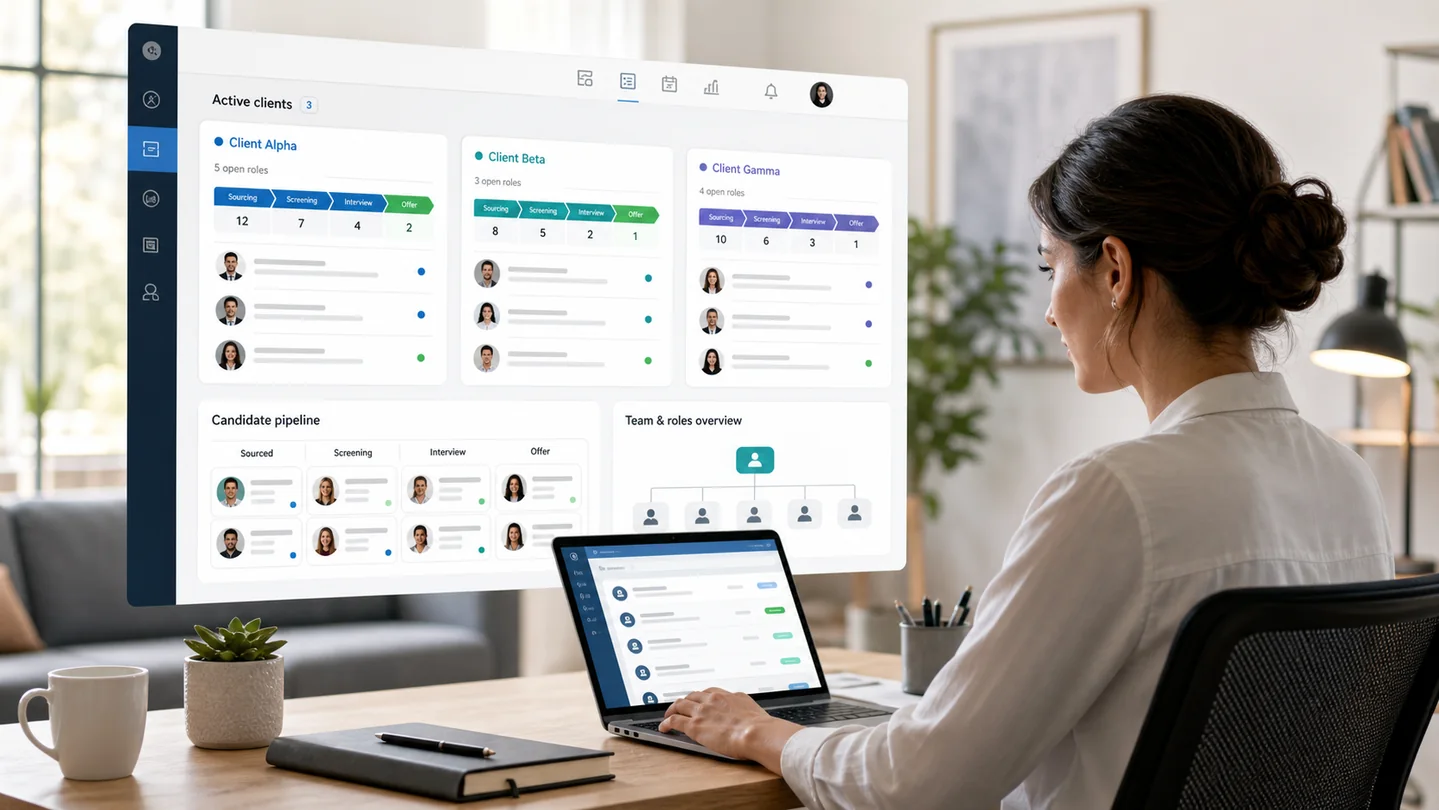
Short answer: a freelance recruiter benefits most from a system that separates each client company, records every role and candidate submission, and keeps follow-up visible. Hirings Online gives direct employers, independent recruiters, and agencies different account structures so a solo recruiter does not have to run every client from one crowded spreadsheet.
This guide answers the questions recruiters commonly ask before choosing recruitment software: how to find clients, how to manage multiple hiring pipelines, what an ATS should do, what can be started free, and when premium features become useful.
What does a freelance recruiter actually need?
A freelance recruiter is not simply an employer with a different title. One week may involve sourcing designers for a startup, screening sales candidates for a regional business, and following up on interviews for a third client. The work becomes difficult when client notes, CV files, job requirements, and candidate statuses live in separate inboxes.
The practical goal is not to automate every conversation. It is to create one reliable operating system for the work that must not be forgotten.
Separate client workspaces
Keep jobs, resumes, organization details, and team access connected to the correct client company.
Visible hiring pipelines
Know who has applied, who needs review, and which client is waiting for an update.
Explainable ATS review
Compare resume evidence with a real job description without treating a score as an automatic hiring decision.
How can a freelance recruiter find clients?
The broad question "How do I get recruitment clients?" becomes easier when it is split into a repeatable process. Choose a market you understand, identify businesses with a visible hiring need, and offer a specific recruiting outcome rather than a generic promise to find anyone for any role.
Choose a narrow starting market
Define a role family, industry, location, or hiring problem you can explain credibly. Examples include remote product designers, hospitality hiring in the Gulf, bilingual customer support, or contract software engineers.
Build proof before sending outreach
Create a professional recruiter profile, describe your screening process, and prepare a short sample market map or anonymized shortlist format. Never publish a candidate's identity without an appropriate basis and permission.
Contact companies with an active reason to talk
Look for recently advertised roles, expansion announcements, repeated vacancies, or skills that are difficult to source. Personalize the message around the hiring need instead of sending the same pitch to hundreds of companies.
Make the first project easy to evaluate
Agree on the role requirements, fee or project scope, candidate ownership, replacement terms, communication schedule, and what counts as a successful introduction before work begins.
Turn delivery into a referral system
Send concise progress updates, document feedback, and ask satisfied clients for a testimonial or introduction. A recruiter wins repeat business by being clear and dependable, not by sending the largest number of CVs.
How do you manage multiple recruitment clients?
Each client needs its own source of truth. A shared spreadsheet can work for one early assignment, but it becomes risky when similar job titles, confidential resumes, and different hiring managers overlap. Hirings Online lets eligible freelance recruiter and agency plans create separate client workspaces under one employer account.
| Information | Where to keep it | Why it matters |
|---|---|---|
| Client and role brief | Client workspace and job post | Prevents requirements from being mixed between companies. |
| Candidate resume | Private resume library | Keeps the original file linked to the correct workspace and assessment. |
| Job match evidence | ATS screening report | Shows matched and missing terms for human review. |
| Recruiter access | Recruiting team membership | Limits workspace access to authorized colleagues. |
| Departments and reporting lines | Organization chart | Helps recruiters understand who owns the role and where it sits. |
A simple weekly recruiter operating rhythm
- Review open roles and stale candidate stages at the beginning of the week.
- Confirm changed requirements before sourcing more candidates.
- Record every candidate submission in the correct client workspace.
- Send clients a short update with progress, blockers, and the next decision needed.
- Close or archive work that no longer has an active hiring mandate.
What should ATS software do for a recruiter?
An applicant tracking system should make candidate review more consistent and easier to explain. On Hirings Online, an employer can upload PDF or DOCX resumes to a private workspace, select an existing job or paste a job description, and receive a job-specific comparison with matched terms, missing terms, and formatting observations.
The score is an organizing signal, not a hiring verdict. A recruiter still needs to read relevant resumes, check transferable experience, provide accommodations where needed, and keep a person responsible for every decision. The ATS resume checker guide explains the matching method in more detail.
Can recruiters use Hirings Online for free?
Yes. A recruiter can start with the Free Employer plan to test a real workflow before paying. Current free allowances include one company workspace, one recruiting seat, up to two active job posts, a private library for up to ten resumes, and 25 ATS comparisons. Limits can change as the product develops, so the plans page is the source for current allowances.
Start free when you need to validate the workflow
- Publish a small number of active roles.
- Keep resumes in one private company workspace.
- Run explainable job-to-resume comparisons.
- Learn the dashboard before inviting a team.
Consider premium when client work becomes repeatable
- Create separate client company workspaces.
- Increase job, resume, ATS, and organization limits.
- Screen resumes in bulk on eligible plans.
- Invite recruiters and share controlled access.
Direct employers who hire for one organization can use the employer structure. Independent recruiters managing several client companies should select Freelance Recruiter. Firms with several recruiters, clients, jobs, and shared candidate pools should select Recruitment Agency during registration.
How should recruiters protect candidate information?
A resume contains personal information. Keep only what is needed for a defined recruitment purpose, tell candidates how their information will be used, restrict access, and establish a retention or deletion process. Requirements vary by location and situation, so recruiters should obtain appropriate legal advice for their business.
The UK Information Commissioner's Office provides detailed recruitment and selection data guidance. The European Commission also explains the principles of lawful, fair, transparent, minimal, accurate, and secure processing in its GDPR guidance for organizations.
Frequently asked questions from recruiters
Can I work as a freelance recruiter without owning an agency?
Yes, subject to the business, licensing, tax, employment-agency, and data-protection rules that apply where you operate and where your clients or candidates are located. Use the Freelance Recruiter account type when you independently manage several client companies.
What is the best niche for a new freelance recruiter?
The best starting niche is one where you understand the roles, know how to evaluate evidence, and can reach employers with active demand. A narrow credible specialty is usually easier to explain than offering every type of recruitment.
How do freelance recruiters charge clients?
Common models include contingency placement fees, retained search, project fees, hourly sourcing, and recruitment-process support. Define the scope, payment trigger, candidate ownership, replacement terms, taxes, and refund conditions in a written agreement.
How many clients can one recruiter manage?
There is no universal number. Capacity depends on role difficulty, vacancy volume, client response times, sourcing channels, and service level. Set a limit based on the decisions and follow-up you can complete reliably, not only on how many roles you can open.
Is an ATS useful for a solo recruiter?
Yes, once more than one active role or client creates repeated tracking work. An ATS gives the recruiter a consistent place for jobs, resumes, screening evidence, and team access instead of relying on memory and inbox searches.
Can ATS scoring choose the best candidate automatically?
No. A score can help organize review, but it cannot understand every career path or replace structured human assessment. The U.S. EEOC has warned that algorithmic hiring tools can create disability discrimination risks when safeguards and accommodations are missing.
How do I avoid sending the same candidate to the wrong client?
Use separate client workspaces, confirm candidate interest and submission terms, and record every introduction against the correct role. Do not rely on filenames or a single download folder as your tracking system.
When should a freelance recruiter upgrade from a free plan?
Upgrade when one workspace, one seat, resume storage, active-job limits, or ATS allowances begin to restrict real client delivery. Premium should solve an observed capacity problem, not be purchased only because more features sound useful.
Build a cleaner recruiting workflow
Create an employer account, choose Direct Employer, Freelance Recruiter, or Recruitment Agency, and begin with the plan that matches the work you have today.
- Share This Job

Write A Comment
No Comments